This guide collects 40 SAP SuccessFactors interview questions and answers used in real functional, technical, and consultant interviews, organized by topic: platform basics, Employee Central, Recruiting and Onboarding, Performance and Talent modules, Learning and Payroll, integration and security, and scenario-based questions for experienced candidates.
Each answer is written to be usable as-is in an interview, direct and specific rather than padded, and grounded in how SAP SuccessFactors actually works today. If you want the hands-on practice behind these answers, see the SAP SuccessFactors online training course this guide is paired with.
40 SAP SuccessFactors interview questions, organized from platform basics to scenario-based questions.
Platform Basics
1 What is SAP SuccessFactors?
SAP SuccessFactors is SAP’s cloud Human Capital Management platform, officially branded the SAP SuccessFactors HXM Suite. It covers core HR data, recruiting, onboarding, performance, compensation, succession, learning, and payroll in one connected, browser-based system.
2 What does HXM stand for, and how is it different from HCM?
HXM stands for Human Experience Management, SAP’s current branding for what was previously called the HCM (Human Capital Management) Suite. Both names refer to the same product; HXM reflects SAP’s shift in emphasis toward employee experience alongside core HR administration.
3 What are the core modules in the SAP SuccessFactors HXM Suite?
Employee Central (core HR and system of record), Recruiting, Onboarding, Performance & Goals, Compensation, Succession & Development, Learning, and Employee Central Payroll. Work Zone for HR and People Analytics sit alongside these as platform-wide capabilities.
4 How is SAP SuccessFactors different from SAP ERP HCM (on-premise)?
SAP ERP HCM is installed and maintained on local infrastructure and organized around infotypes and Personnel Administration. SAP SuccessFactors is cloud SaaS, updated by SAP on a regular release cycle, and organized around Employee Central’s data model, MDF objects, and business rules.
5 What is Provisioning in SAP SuccessFactors?
Provisioning is the back-end administrative console used to configure system-level settings: enabling modules, setting up company structure basics, managing super admin access, and configuring options not exposed in the standard Admin Center.
6 What is the Admin Center used for?
Admin Center is where day-to-day administrators manage users, permissions, business configuration (MBC), email notifications, picklists, and most module-level settings without needing Provisioning access.
7 Does SAP SuccessFactors configuration require coding?
No. Configuration is done through Provisioning, Admin Center, Manage Business Configuration, and rule-builder UIs using if/then logic rather than a programming language, though Employee Central integrations may involve OData or SFTP-based technical work.
Employee Central
8 What is Employee Central?
Employee Central is the core HR module and system of record in SAP SuccessFactors. It stores employee master data, job and compensation information, and organizational structure, and every other HXM module reads from and writes back to it.
9 What is a Foundation Object in Employee Central?
A Foundation Object holds data shared across the whole company, such as job codes, departments, cost centers, or locations. Foundation Objects are sometimes called foundation tables and form the organizational backbone Employee Central builds on.
10 What is the difference between a Foundation Object and a Generic Object (MDF object)?
Foundation Objects are the standard, SAP-delivered organizational data types (job code, department, location). Generic Objects are custom objects built on the Metadata Framework (MDF) for data SAP doesn’t model out of the box, defined by the implementation team.
11 What is MDF (Metadata Framework)?
MDF is the framework used to create Generic Objects, custom fields, and associations that extend Employee Central’s data model beyond standard fields, letting administrators model organization-specific data without custom code.
12 What is Role-Based Permission (RBP)?
RBP is SAP SuccessFactors’ security model. It grants access to data and actions based on a user’s assigned role (defined by target population and permission groups) rather than granting permissions to individual users one by one.
13 What are business rules, and what trigger events do they support?
Business rules are if/then logic built in Configure Business Rules and assigned in Manage Business Configuration to automate defaults, validations, and workflow triggers. They fire on onInit (screen load), onChange (field edited), onSave (record saved), or onDelete.
14 What is Position Management in Employee Central?
Position Management models jobs as positions independent of the person filling them, tracking a position’s own attributes, reporting line, and history. It’s typically used by organizations that plan headcount and org structure position-by-position rather than person-by-person.
Recruiting & Onboarding
15 What is Recruiting Management in SAP SuccessFactors?
Recruiting Management is SuccessFactors’ applicant tracking system: creating job requisitions, sourcing and screening candidates, managing interviews, and generating offers, all tracked against a configurable requisition and candidate workflow.
16 What is a job requisition?
A job requisition is the record that defines an open position for recruiting purposes, built from a requisition template with fields, picklists, and approval routing configured for that role or business unit.
17 What’s the difference between Recruiting Management and Recruiting Marketing?
Recruiting Management handles the internal applicant tracking process (requisitions, candidates, offers). Recruiting Marketing handles the candidate-facing side: career sites, job postings, and campaigns used to attract candidates into that pipeline.
18 What does the Onboarding module do?
Onboarding manages new-hire data collection, digital paperwork, task assignment, and mentor connections between an accepted offer and a productive first weeks on the job, and also supports cross-boarding and offboarding.
19 What is cross-boarding?
Cross-boarding is the Onboarding process applied to internal moves, transfers, or promotions rather than external new hires, reusing the same guided-task framework for employees changing roles inside the organization.
20 How does Onboarding connect to Recruiting and Employee Central?
An accepted offer in Recruiting triggers the Onboarding process, which collects and validates new-hire data, then hands that data to Employee Central to create the employee’s official record once onboarding tasks are complete.
Performance, Compensation & Succession
21 What does the Performance & Goals module cover?
Performance & Goals covers goal plan setup and cascading, performance review form templates, rating scales, and 360-degree feedback. It’s the most frequently implemented talent module in the HXM Suite.
22 What is continuous performance management?
Continuous performance management refers to ongoing check-ins and ad hoc feedback captured throughout the year, supplementing or replacing a single annual review cycle with more frequent, lighter-weight conversations.
23 What does Compensation Management cover?
Compensation Management covers compensation planning templates and worksheets used to allocate merit increases, bonuses, and promotion budgets, with eligibility rules and multi-currency support for global workforces.
24 What is Variable Pay?
Variable Pay is a companion module to Compensation that calculates more complex, formula-based incentive pay, such as bonuses tied to performance ratings, targets, or company results, rather than flat merit increases.
25 What does Succession & Development cover?
Succession & Development covers succession org charts and nominations, talent pools, and calibration sessions used to identify and develop high-potential employees and plan coverage for critical roles.
26 What is Career Development Planning (CDP)?
CDP is the part of Succession & Development where employees plan career growth: identifying target roles, the competencies required to reach them, and development activities to close the gap.
Learning & Payroll
27 What does the Learning module (LMS) manage?
Learning manages learning items, programs, and curricula, assignment profiles that push required training to the right audience, and completion tracking for both elective and compliance-driven training.
28 What is Employee Central Payroll (ECP)?
Employee Central Payroll is SAP’s payroll engine run on cloud infrastructure alongside Employee Central. It reuses core SAP payroll logic (wage types, schemas) while integrating tightly with Employee Central as the source of employee master data.
29 What is the Payroll Control Center?
The Payroll Control Center (PCC) is the dashboard used to run and monitor payroll: pre-payroll monitoring, simulations, alerts, and post-processing tasks like posting results to finance, replacing older, less visible batch-style monitoring.
30 What is point-to-point integration between Employee Central and ECP?
Point-to-point integration is the standard method for replicating master data, like job and compensation changes, from Employee Central into Employee Central Payroll so payroll always runs against current employee data.
31 What is a wage type?
A wage type is a core payroll element representing an earning or deduction, such as base salary or a tax withholding. Wage types are categorized as primary or secondary/technical and are tied to specific infotypes.
Integration & Security
32 How does SAP SuccessFactors integrate with other systems?
Through prebuilt adapters and APIs (OData, REST/SOAP), Integration Center for building and scheduling data flows, SAP BTP/Integration Suite for more complex scenarios, and middleware such as SAP CPI for connecting to third-party or on-premises systems.
33 What is Integration Center?
Integration Center is a SuccessFactors tool for building, scheduling, and monitoring integrations, exports, and imports without writing custom code, commonly used for recurring file-based or API-based data exchanges.
34 What is Work Zone for HR?
Work Zone for HR is the unified employee portal for the HXM Suite, the module formerly known as SAP Jam, giving employees one place to access tasks, announcements, and linked HR applications.
35 How does SAP SuccessFactors control who can see or edit what data?
Primarily through Role-Based Permissions, which grants access to specific data and actions based on a user’s role definition (target population plus permission group), layered with data-model-level visibility settings that cap what any permission can expose.
Scenario-Based Questions
36 A business rule you configured isn’t firing on save. How do you troubleshoot it?
Confirm the rule is actually assigned to the correct object and trigger event in Manage Business Configuration, not just created in Configure Business Rules. Then check the IF conditions and field data types match, and use browser dev tools or rule trace to confirm the rule call fires.
37 How would you approach a project migrating a client from SAP ERP HCM to SuccessFactors?
Start by mapping ERP HCM infotypes to Employee Central’s data model and identifying gaps that need Foundation or Generic Objects. Run parallel data validation before go-live, and sequence rollout module by module, typically Employee Central first, then talent modules and payroll.
38 A department head is resistant to adopting a new module. How do you handle it?
Meet with them directly to understand the specific concern rather than assuming, then demonstrate the module against their actual use case rather than a generic demo. Pair that with hands-on training and early support so the resistance is addressed with evidence, not just reassurance.
39 Walk through how you’d configure an approval workflow for a promotion change.
Define the workflow object and its approval steps, assign the relevant approvers by role (such as manager and HRBP), then attach the workflow to trigger from a business rule on the Job Information or Compensation Information event tied to the promotion change.
40 How would you design a solution to keep cost center data consistent between Employee Central and a downstream finance system?
Model cost centers as Foundation Objects in Employee Central as the single source of truth, then use Integration Center or a scheduled point-to-point/API integration to propagate additions and changes to the finance system, with validation rules preventing invalid cost center assignments upstream.
Tips for Your SAP SuccessFactors Interview
Anchor answers in Employee Central
Almost every follow-up question comes back to how a module reads from or writes to Employee Central. Practice explaining that connection for each module, not just the module in isolation.
Know the trigger events cold
onInit, onSave, onChange, and onDelete come up constantly for both functional and technical interviews. Be able to say which event fits a given scenario, not just define the terms.
Prepare one real project story
Scenario questions reward specifics: which module, what the requirement was, and what you configured. A vague “I worked on Employee Central” answer reads very differently from a walked-through example.
Separate what SAP does from what you configure
Interviewers notice when a candidate confuses standard, SAP-delivered behavior with something a consultant configures. Naming the difference (Foundation Object vs. Generic Object is a common example) signals real hands-on experience.
More Interview Questions
If your interview covers integration or adjacent Oracle EPM tools, these companion guides go deeper on those specific areas:
Most SAP SuccessFactors interviews test the same underlying thing regardless of module: whether you understand Employee Central as the system every other module depends on, and whether you can explain configuration decisions, not just definitions. The 40 questions above cover that range, from platform basics through scenario-based questions for experienced consultants.
If you want structured, hands-on practice with the concepts behind these answers, including Employee Central, Payroll, and every talent module, the course below covers all of it with a real-time project.
Get Interview-Ready with SAP SuccessFactors Training
Live instructor-led classes, hands-on configuration, and certification guidance, covering every module referenced in this guide.
SAP SuccessFactors online training covers Employee Central, Payroll, talent modules, and real-time project work.
SAP SuccessFactors Online Training
SAP SuccessFactors online training from SpiritSofts teaches you how to configure and run SAP’s cloud Human Experience Management (HXM) suite, from Employee Central as the core system of record through Recruiting, Onboarding, Performance & Goals, Compensation, Succession & Development, Learning (LMS), and Employee Central Payroll. The course moves from platform foundations and provisioning through hands-on, module-by-module configuration, so you finish with working knowledge you can apply on a real SAP SuccessFactors project.
This guide covers the full curriculum, prerequisites, architecture, career paths, certification path, and batch options, along with answers to the questions learners ask most before enrolling. Instructor-led sessions run online, so the schedule works whether you’re joining from Hyderabad, New York, London, Dubai, or Singapore.
Quick Course Overview
SAP SuccessFactors online training at a glance
Course
SAP SuccessFactors (HXM Suite) Online Training
Mode
Live, instructor-led online training with corporate and self-paced options
Every live class is recorded and shared for later review
Delivery platform
Live online streaming (WebEx / GoToMeeting)
Practical work
Hands-on configuration exercises with trainer-provided environment access and a real-time project
Ideal for
HR professionals, HRIS analysts, SAP consultants, managers, freshers targeting SAP HCM/HXM roles
Support
Certification guidance, interview preparation, placement support
Global availability
Learners across India, USA, UK, Europe, UAE/GCC, Australia, Singapore, Africa, and Canada
Provider
SpiritSofts, Hyderabad, India
SAP SuccessFactors online training covers Employee Central, talent modules, and real-time project work.
What Is SAP SuccessFactors?
SAP SuccessFactors is SAP’s cloud-based Human Capital Management (HCM) platform, officially branded the SAP SuccessFactors HXM Suite (Human Experience Management). It manages the full employee lifecycle, core HR data, payroll, recruiting, onboarding, performance, compensation, succession planning, and learning, in one connected, browser-based system.
At the center of the suite sits Employee Central, the core HR module and system of record for employee data. Every other module, Recruiting, Onboarding, Performance & Goals, Compensation, Succession & Development, and Learning, reads from and writes back to that same employee record, which is what lets a single hire flow from job requisition through onboarding, performance reviews, and career development without re-entering data in separate systems.
SuccessFactors is SAP’s cloud successor to the on-premises SAP ERP HCM module, and organizations frequently run this training specifically to support that on-premises-to-cloud transition. Training candidates search for this course under several related names, including SAP SuccessFactors training, SAP HCM cloud training, SAP HXM training, and SuccessFactors Employee Central training; all of these point to the same platform and the same core skill set covered here.
Why Learn SAP SuccessFactors?
SAP SuccessFactors is consistently ranked among the market-leading cloud HCM platforms, and it’s the direction SAP is actively moving its large installed base of on-premises SAP ERP HCM customers toward. That migration wave, combined with the suite’s own module depth, keeps demand steady for people who can configure and support it.
For learners, that translates into a specific, in-demand skill set rather than a generic HR-software overview. Organizations typically need module-specific expertise, Employee Central, Recruiting, Onboarding, Performance & Goals, Compensation, Succession & Development, or Learning, so this course works well both as a standalone HR-tech specialization and as a cloud-transition path for consultants who already know SAP ERP HCM.
Because Employee Central acts as the system of record for every other module, understanding its data model, security, and integration points is what turns a functional HR user into someone who can actually implement and support the platform.
Every live class is recorded and shared, so you can revisit modules or catch up after a missed session.
Real-World Scenarios
Practical, project-oriented training built around real HR configuration scenarios, not slides alone.
Expert Trainers
Sessions are led by trainers with hands-on, real-time SAP SuccessFactors implementation experience.
Certification Guidance
Preparation support aligned to SAP’s SuccessFactors certification paths, starting with Employee Central Core.
Placement Support
Resume input, interview preparation, and job support to help you apply your skills after training.
Who Should Attend SAP SuccessFactors Training?
This course is built for people who will actually configure, administer, or work inside SAP SuccessFactors, rather than as a general HR-software overview.
HR professionals looking to upskill into cloud HCM/HXM systems.
Managers and business leaders who want to streamline HR operations through the platform.
SAP consultants, including those moving from on-premises SAP ERP HCM into cloud SuccessFactors delivery.
HRIS analysts and HR systems administrators who will own configuration and support.
Freshers and career switchers targeting SAP HCM/HXM job openings.
Corporate HR and IT teams standardizing on SAP SuccessFactors internally.
SAP SuccessFactors Training Prerequisites
There’s no mandatory coding prerequisite for SAP SuccessFactors training. Configuration is done through Provisioning, Admin Center, and business rules rather than programming languages, so a working familiarity with HR processes and general business applications is enough to start.
Learners who already know SAP ERP HCM (on-premises) will recognize the underlying HR concepts more quickly, since many organizations use this course specifically to bridge into SuccessFactors, but that background isn’t required. Complete beginners are supported through the platform-foundations module before the course moves into module-by-module configuration.
SAP SuccessFactors Course Curriculum
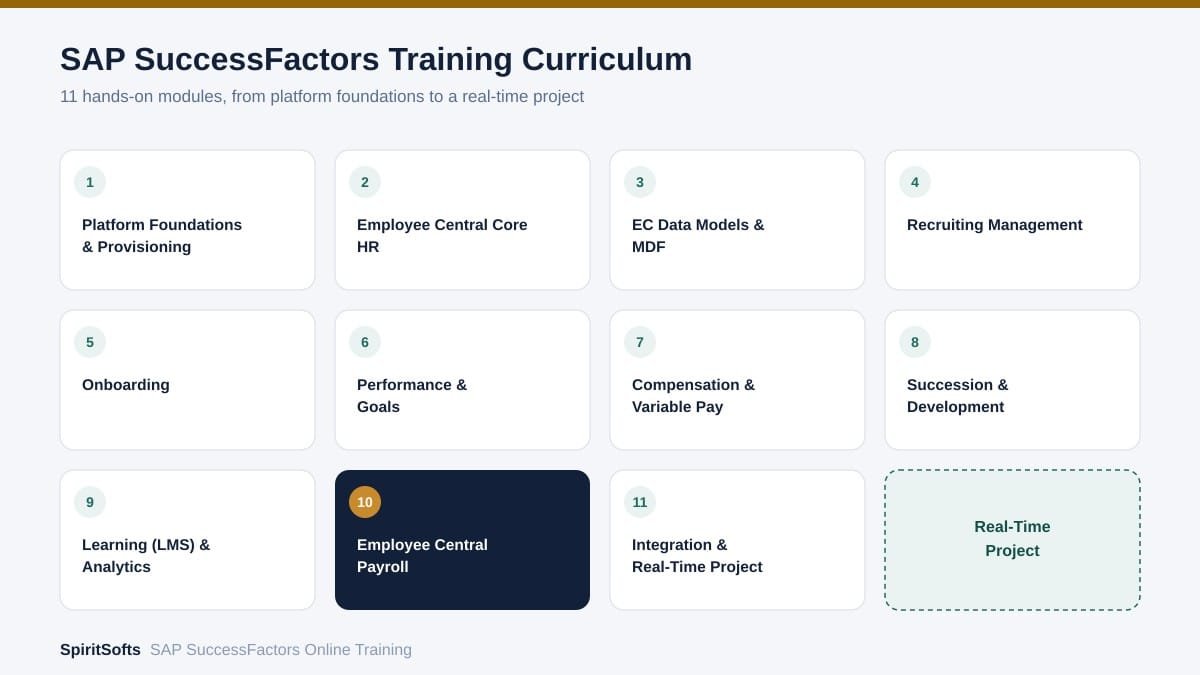
The curriculum is organized into eleven modules that follow how a real implementation is built: platform foundations first, then Employee Central as the core system of record, then the talent modules that connect to it, then payroll, integration, and the real-time project.
Understanding the SuccessFactors HXM Suite, Instance, and Provisioning
Basic company settings in Provisioning and creating administrators
Instance basics: passwords, home page, welcome menu, company info, employee files
Admin Center tools, admin privileges, and company logo setup
Commonly used terms and the standard implementation methodology
Managing data user records, employee data files, and permissions
Password policies, email notifications, and change engine configuration
Text customization, rating scales, and route maps
Employee Profile, XML and data models, and picklists
Role-Based Permissions (RBP) fundamentals
Reporting basics: process dashboards, rating scale dashboards, and interactive dashboards
Reporting Admin: managing report permissions, list view, spotlight, spreadsheet, classic, and ad hoc reports
2 Employee Central Core HR & Position Management
Employee Central as the core HCM module and system of record
Provisioning setup exercises and enabling Employee Central and RBP
Updating employee details and ESS/MSS (self-service) functionality
Understanding and managing security with Role-Based Permissions
Position Management concepts and configuration
Employee Central reporting and integration touchpoints, including EC Payroll integration
3 Employee Central Data Models, MDF & Business Rules
Data models and DTDs, and Employee Central structure
Data model management and data model associations
Customizing and populating basic foundation data, including country-specific foundation tables
Creating and modifying associations, and propagations
Importing users and data, and running mass changes
Customizing employee files and Country-Specific Fields (CSF)
MDF (Metadata Framework) overview and creating MDF objects
Business rules setup for validation and derived values
4 Recruiting Management & Recruiting Marketing
Introduction to Recruiting, instance setup, and applicant status configuration
Recruiting operators and recruiting resources
Enabling and creating job requisitions, and configuring requisition templates
Requisition field permissions, job search fields, and requisition picklists
Requisition headers and footers, candidate profile, and candidate screening questions
Offer approval templates, offer letter templates, and generating offers
Setting up agencies and configuring email templates
5 Onboarding
Onboarding process design: new-hire data collection and digital forms
Task assignment, mentor/buddy connections, and equipment/system access provisioning
Integration between Onboarding, Recruiting, and Employee Central
Cross-boarding for internal moves and configuring offboarding
6 Performance & Goals
Goal plan setup, goal libraries, and cascading goals
Performance review form templates and rating scales
Continuous performance management and check-ins
360-degree feedback and calibration basics
7 Compensation & Variable Pay
Compensation planning templates and worksheets
Merit increases, bonus guidelines, and promotion budgets
Variable Pay plan setup and calculation logic
Eligibility rules and multi-currency compensation basics
8 Succession & Development
Succession org charts and nomination configuration
Talent pools and calibration/talent review sessions
Career Development Planning (CDP) setup
Matching employees to future roles and identifying competency gaps
9 Learning Management (LMS) & People Analytics
Learning items, programs, and curricula setup
Assignment profiles and compliance training tracking
Learning reporting and completion tracking
People Analytics fundamentals for HR reporting and workforce insights
10 Employee Central Payroll (ECP)
Employee Central Payroll positioning: core payroll engine plus Employee Central, run on cloud infrastructure
Master data integration (“point-to-point integration”) and master data replication between Employee Central and ECP
Wage type configuration, primary vs secondary/technical wage types, and related infotypes
Payroll Control Center: pre-payroll monitoring, simulations, post-processing, and alerts
Pay statements, off-cycle payments, and retroactive changes
Payroll integration touchpoints with time management, benefits, and finance
11 Integration, Real-Time Project & Best Practices
Integration Center and SAP BTP/Integration Suite touchpoints for connecting SuccessFactors to other systems
Work Zone for HR as the unified employee portal
Hands-on, real-time SAP SuccessFactors project spanning Employee Central through a talent module and payroll
Implementation best practices and open questions and answer session
SAP SuccessFactors Architecture
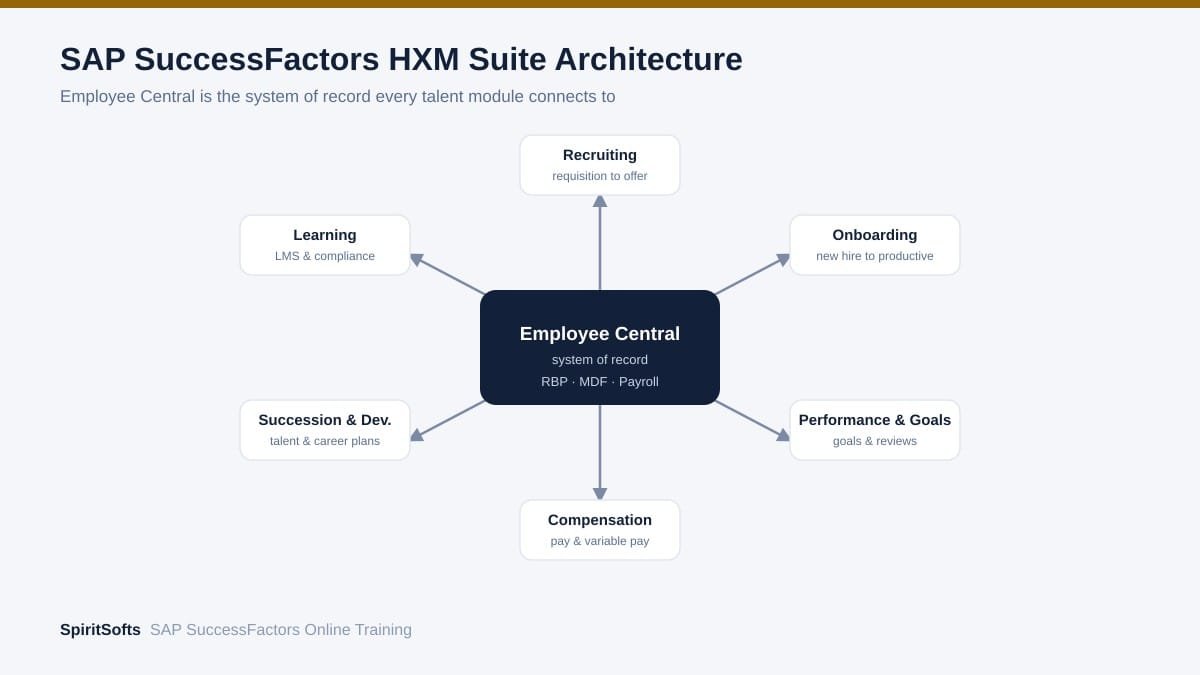
Employee Central sits at the center of the SuccessFactors HXM Suite as the system of record. Every talent module, Recruiting, Onboarding, Performance & Goals, Compensation, Succession & Development, and Learning, reads employee data from Employee Central and writes changes back to it, which is what keeps a single employee record consistent as that person moves from candidate to new hire to established employee.
Configuration across the suite relies on a shared set of platform tools: Provisioning for system-level setup, Role-Based Permissions (RBP) for security, the Metadata Framework (MDF) for custom objects, and business rules for validation and derived values. Data moves in and out of the suite through Employee Central Payroll integration and the Integration Center/SAP BTP, often alongside middleware such as SAP CPI (Cloud Platform Integration) for connecting to third-party systems, while Work Zone for HR (the module formerly known as SAP Jam) provides a unified portal for employees to access everything in one place.
SAP SuccessFactors vs SAP ERP HCM (On-Premises)
SAP ERP HCM is SAP’s on-premises HR system, installed and maintained on local infrastructure. SAP SuccessFactors is the cloud HXM evolution of that same functional space, delivered as SaaS, updated continuously by SAP, and built around Employee Central as the shared system of record for every connected module.
SAP ERP HCM vs SAP SuccessFactors comparison
Aspect
SAP ERP HCM (on-premises)
SAP SuccessFactors (cloud HXM)
Deployment
Installed and hosted on local/on-premises servers
Cloud SaaS, accessed through a browser
Maintenance & updates
Managed by internal IT/Basis teams, manual upgrades
Integration Center, SAP BTP/Integration Suite, prebuilt connectors
Typical use
Legacy or fully on-premises SAP landscapes
Cloud-first or hybrid SAP landscapes migrating off ERP HCM
Learners coming from an SAP ERP HCM background typically need to re-map familiar infotype thinking onto Employee Central’s data model and MDF objects, which this course covers directly in Modules 2 and 3.
Real-Time SAP SuccessFactors Projects & Hands-On Exercises
Training is structured around a real-time project rather than isolated module demos. Typical hands-on exercises include:
Setting up Provisioning and configuring Role-Based Permissions for different user groups
Building an Employee Central foundation data model and creating MDF objects
Configuring a job requisition template and running it through to offer generation in Recruiting
Building an Onboarding process that carries a new hire’s data from Recruiting into Employee Central
Creating a goal plan and a performance review form template in Performance & Goals
Building a compensation worksheet template with eligibility rules
Configuring a succession org chart and a Career Development Planning template
Assigning a Learning curriculum and tracking completion
Trainer-provided environment access means these exercises are performed hands-on rather than watched, which is the same skill set assessed in interviews and used on live SAP SuccessFactors implementation and support assignments.
SAP SuccessFactors Use Cases
Cloud HCM Migration
Modeling Employee Central and connected modules while migrating off on-premises SAP ERP HCM.
Hire-to-Retire Process
Running a single employee record consistently from Recruiting through Onboarding, Performance, and Succession.
Global Payroll Alignment
Connecting Employee Central to Employee Central Payroll or third-party payroll across countries.
Talent & Succession Planning
Building succession org charts and development plans for critical roles.
SAP SuccessFactors Interview Preparation
Interview preparation support focuses on the areas hiring managers actually probe: how Employee Central’s data model and MDF objects work, how Role-Based Permissions control access, how Recruiting hands data to Onboarding and then to Employee Central, and how Performance & Goals, Compensation, and Succession & Development connect back to that same employee record. Sessions include scenario-based questions, such as troubleshooting a permission issue or designing a compensation eligibility rule, since these mirror how SuccessFactors knowledge is tested in real interviews.
SAP’s flagship entry point is the SAP Certified Associate – SAP SuccessFactors Employee Central Core certification, administered through SAP Learning. SAP also offers module-specific certification paths for Recruiting, Onboarding, Performance & Goals, Compensation, Succession & Development, and Learning.
Training maps directly to the skill areas these certifications test, and includes certification preparation guidance covering exam scope and practice-oriented review. Exam formats and codes are updated by SAP on a recurring cycle, so always confirm the current exam name and format on SAP Learning before booking. The certification itself is administered and awarded by SAP; SpiritSofts training supports your preparation for it but does not issue the SAP credential.
SAP SuccessFactors Career Opportunities & Job Roles
SAP SuccessFactors skills are typically requested by module specialization, so most professionals build depth in one or two modules alongside broader HCM/HXM awareness. Common roles include:
Common SAP SuccessFactors-related job roles
Job Role
What They Do
Employee Central Consultant
Configures data models, MDF objects, business rules, and RBP
SAP SuccessFactors Recruiting Consultant
Implements job requisition, sourcing, and offer workflows
SAP SuccessFactors Onboarding Consultant
Builds new-hire, cross-boarding, and offboarding processes
Performance & Compensation Consultant
Configures goal plans, review forms, and compensation worksheets
HRIS Analyst / HR Systems Analyst
Owns day-to-day configuration, support, and reporting
SAP SuccessFactors Techno-Functional Consultant
Handles integration, Integration Center, and SAP BTP connections
SAP SuccessFactors Skills Required
The skills that matter most on the job are the same ones covered in this course: configuring Employee Central’s data model and MDF objects, managing Role-Based Permissions, building requisition and onboarding workflows, setting up goal and compensation templates, and configuring succession and learning processes. Familiarity with Integration Center and basic SAP BTP concepts is a useful addition for techno-functional roles.
SAP SuccessFactors Training Options
Training is available in formats built around how people actually study and work, rather than a single fixed schedule.
Instructor-Led Online Training
Live, structured classes with direct trainer interaction over WebEx or GoToMeeting.
Self-Paced Learning
Flexible online training with lifetime access to recorded course materials.
Weekday & Weekend Batches
Flexible batch timings for full-time employees and students studying around other commitments.
Corporate Training
Team-based training tailored for organizations standardizing internal SAP SuccessFactors capability.
Because batches run online and recordings remain available afterward, learners in different time zones, from Eastern Time in the USA to GST in the UAE to IST in India, can join a live batch or catch up through recordings without losing continuity.
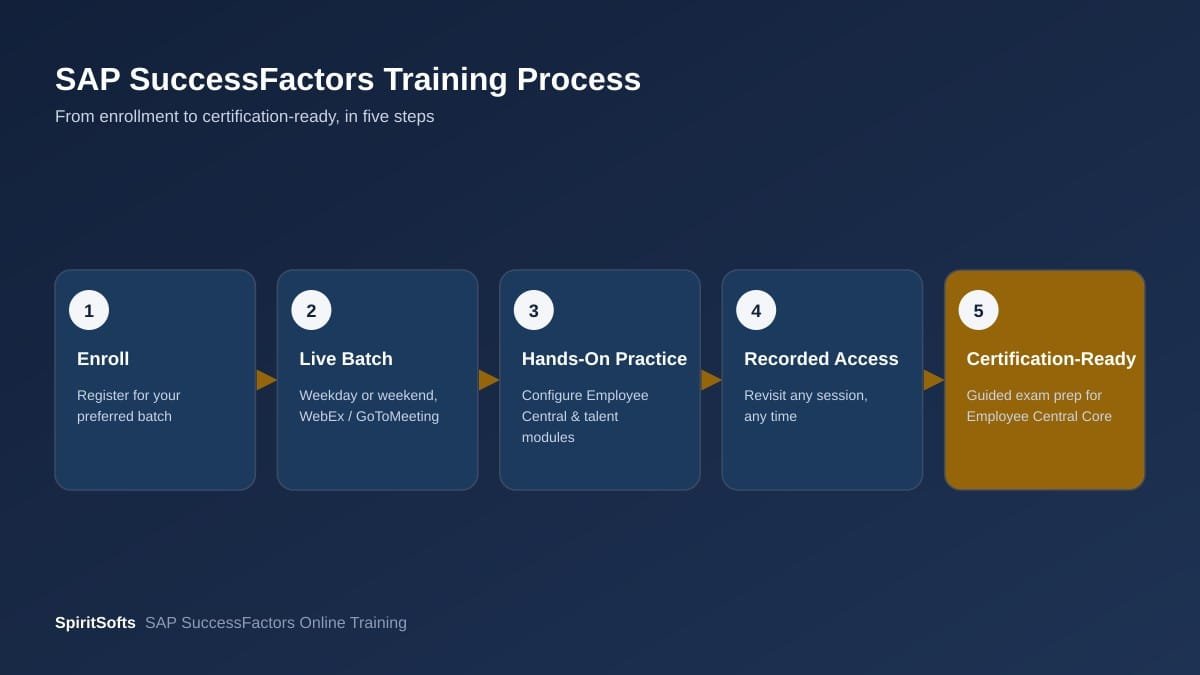
The SAP SuccessFactors training process: live batch, hands-on configuration, and recorded sessions.
Global SAP SuccessFactors Online Training Availability
Because training runs live online with recorded playback, location is rarely the limiting factor, timezone overlap is. Batches are scheduled to give reasonable overlap for major regions, and recordings cover the rest.
Based in Hyderabad. SpiritSofts is headquartered in Kukatpally, Hyderabad, Telangana, one of India’s major IT and software hubs alongside HITEC City and Gachibowli. Learners searching for SAP SuccessFactors training in Hyderabad get IST-native batch timing by default, with the same live, instructor-led format used for every other region.
IST afternoon batches with reasonable regional overlap, plus recordings
Enrollment from Latin America (São Paulo, Mexico City, Buenos Aires, and other markets) is also supported; given the wider timezone gap with IST, recorded sessions are the most practical route to stay current with live classes. Wherever you’re based, recorded sessions and ongoing support mean a missed live class never blocks your progress through the curriculum.
Why Choose SpiritSofts for SAP SuccessFactors Training?
SpiritSofts structures SAP SuccessFactors training around practical configuration work rather than a slide-driven walkthrough of the interface.
Training Methodology & Trainer Expertise
Classes are led by trainers with real-time SAP SuccessFactors implementation experience, following a practical approach that pairs each module with hands-on configuration rather than teaching theory in isolation.
Course Materials & Updated Curriculum
The curriculum is kept current with SAP SuccessFactors updates, and self-paced learners get lifetime access to course materials to revisit modules at their own pace.
Practical Use Cases & Placement Support
Training is oriented around real-world HR scenarios and project-based exercises, supported by resume input, interview preparation, and job/placement support to help you apply what you’ve learned.
Certification Guidance & Corporate Training
Certification preparation guidance is built into the curriculum, and corporate teams can arrange group training, with discounts available for groups of more than two participants.
How to Enroll
Submit an enquiry through the form on this page or the Contact Us page.
Speak with the training team about your background and preferred batch (weekday, weekend, or self-paced).
SAP SuccessFactors is SAP’s cloud-based Human Capital Management platform, officially branded the SAP SuccessFactors HXM Suite. It manages core HR data, recruiting, onboarding, performance, compensation, succession, and learning in one connected system.
What is SAP SuccessFactors used for?
Organizations use it to run HR processes end to end: maintaining employee records in Employee Central, hiring through Recruiting and Onboarding, managing performance and pay, planning succession, and delivering training through Learning.
Is SAP SuccessFactors the same as SAP HXM, and how is it different from SAP ERP HCM?
SAP HXM (Human Experience Management) is the current official branding for the SuccessFactors suite; both names refer to the same product. SAP ERP HCM is a separate, older on-premises system that SuccessFactors is designed to replace in the cloud.
Is SAP SuccessFactors difficult to learn?
SuccessFactors has its own configuration concepts, but it doesn’t require programming. Learners with general HR-process or business-application familiarity typically become comfortable with Provisioning, Employee Central, and the talent modules within the first few sessions.
Does SAP SuccessFactors training require coding knowledge?
No. Configuration happens through Provisioning, Admin Center, and business rules rather than programming languages, so no prior coding background is required to complete this course.
Do I need SAP ERP HCM experience before joining?
It’s not mandatory. Prior SAP ERP HCM experience helps you map familiar HR concepts onto Employee Central faster, but the course’s foundational modules are designed to support complete beginners too.
Who should attend SAP SuccessFactors training?
HR professionals, managers and business leaders, SAP consultants moving into cloud HCM, HRIS analysts, and freshers or career switchers targeting SAP HCM/HXM roles all benefit from this course.
Is this course suitable for complete beginners?
Yes. Beginners with a general understanding of HR processes can start directly, since the first module builds platform foundations before the course moves into module-by-module configuration.
What is Employee Central in SAP SuccessFactors?
Employee Central is the core HR module and system of record for employee data. Every other SuccessFactors module reads from and writes back to the same employee record maintained here.
What is MDF (Metadata Framework) in SAP SuccessFactors?
MDF is the framework used to build custom objects and extend Employee Central’s data model beyond standard fields, which administrators use to model organization-specific HR data.
What is Role-Based Permission (RBP) in SAP SuccessFactors?
RBP is the security model that controls who can view or edit specific data and actions across the suite, based on a user’s role rather than individual, one-off permission grants.
What does the Recruiting Management module cover?
Recruiting Management covers job requisition creation, candidate sourcing and screening, interview and offer workflows, and agency setup, functioning as SuccessFactors’ applicant tracking system.
What does the Onboarding module cover?
Onboarding manages new-hire data collection, digital forms, task assignment, and mentor connections, and also supports cross-boarding for internal moves and offboarding when employees leave.
What is covered in Performance & Goals?
Performance & Goals covers goal plan setup, performance review form templates, continuous check-ins, and 360-degree feedback, and is the most frequently implemented module in the suite.
What is covered in Compensation and Variable Pay?
Compensation covers planning templates, merit increases, bonus and promotion budgets, and eligibility rules, while Variable Pay handles more complex, formula-based incentive calculations.
What is Succession & Development in SAP SuccessFactors?
Succession & Development covers succession org charts, talent pools, calibration sessions, and Career Development Planning (CDP) for matching employees to future roles.
Does the course cover SAP SuccessFactors Learning (LMS)?
Yes. Module 9 covers Learning items, programs, curricula, assignment profiles, and compliance training tracking, alongside People Analytics for HR reporting.
Does the training cover Employee Central Payroll (ECP)?
Yes. Module 10 covers Employee Central Payroll: master data replication with Employee Central, wage type configuration, the Payroll Control Center, and pay statements.
How long is the SAP SuccessFactors training program?
The course runs as instructor-led live classes across eleven modules, including Employee Central Payroll, scheduled in weekday or weekend batches, with recorded sessions shared so you can revisit any module afterward.
Will I work on real-time projects during training?
Yes. The training is oriented around a real-time project, with hands-on exercises covering Provisioning, Employee Central configuration, Recruiting, Onboarding, and the talent modules using trainer-provided environment access.
Are the classes live, and what happens if I miss a session?
Classes are conducted live online through WebEx or GoToMeeting for direct trainer interaction. Every session is recorded and shared, so a missed class doesn’t interrupt your progress.
What is the cancellation and refund policy?
Registration can be cancelled within 48 hours of initial enrollment, and refunds for eligible cancellations are processed within 30 days of the request.
Is corporate or team training available, and are weekend batches offered?
Yes to both. Corporate training is available for HR and IT teams standardizing on SAP SuccessFactors, weekday and weekend batches are both offered, and group discounts apply for more than two participants.
Does SpiritSofts provide certification guidance?
Yes. The course includes certification preparation guidance aligned with SAP’s SuccessFactors certification paths, starting with Employee Central Core; the certification itself is administered by SAP.
What career opportunities follow SAP SuccessFactors training?
Learners move into roles such as Employee Central consultant, Recruiting or Onboarding consultant, Performance & Compensation consultant, HRIS analyst, and techno-functional consultant, often specializing in one or two modules.
Can learners from the USA, UAE, Europe, or Singapore join this online training?
Yes. Training is delivered live online and is open to learners globally, including the USA, UK, Europe, UAE and GCC countries, Australia, Singapore, and other Asia-Pacific markets, with batch timing arranged around timezone overlap.
Is SAP SuccessFactors training available in Hyderabad?
Yes. SpiritSofts is based in Kukatpally, Hyderabad, and Hyderabad-based learners can join live online batches, attend in the same city’s timezone by default, or ask about in-person guidance at the Hyderabad office alongside the standard online format.
Conclusion
SAP SuccessFactors runs on Employee Central as its shared system of record, and understanding how that core connects to Recruiting, Onboarding, Performance & Goals, Compensation, Succession & Development, and Learning is what separates working knowledge of the suite from a surface-level overview. This training builds that understanding through structured modules and hands-on, real-time project work, backed by recorded sessions, interview preparation, and certification guidance.
Whether you’re starting fresh, moving from on-premises SAP ERP HCM, or training a team, the course is designed to get you configuring real modules, not just reading about them.
Join SAP SuccessFactors Online Training
Batch timings are flexible across weekday, weekend, and self-paced formats, with corporate training available for teams. Reach out to plan your batch.